
According to recent statistics, 68% of the mistakes in interior finishing are caused by improper wall cutting during the installation stages. The process of cutting drywall requires the measurement of correct length, drawing of accurate lines, scoring of surface layers, and breaking of panels along controlled edges.
In the absence of this information, people usually have to contend with imbalanced joints and wastage of material in the course of installation. It involves design planning of layout, marking sheets, and controlled cutting methods.
This framework discusses the working techniques, understanding of the tools, and accuracy steps to ensure that you are confident in the clean results.
Understanding Drywall Cutting, Planning, Layout, Design, and Measurement Basics
The correct planning and measurement are the initial steps of drywall cutting. During this stage, we need to know the wall plan and take down the necessary measurements. Mismeasurement may result in the entire installation being off balance and having joint misalignments.
Construction Planning Insight On The Accuracy Of Materials
Structural planning and quantity analysis are significant at this stage. To comprehend material requirements, calculation of volume, and sequencing of a project routinely, a conceptual undertaking such as an estimate for construction is employed. This can assist in making the planning process structured and minimizing wastage of materials.
Tools And Surface Understanding For How To Cut Drywall
In the case of cutting drywall, it will require knowledge of how the surface and material behave. Gypsum boards are usually made of a stratified structure, which disintegrates following scoring. As a result, shallow cutting and controlled pressure are important.
Knowing the surface will prevent non-uniform breaks. The density of each sheet is similar, with weak edges. This means that it has to be handled.
Drywall Layout Assessment and Material Calculation
Segmentation of the wall surface takes place in this step. Making correct marks minimizes cutting mistakes. At this stage, concept drywall estimation is involved, in which the size of the sheets, the percent wastage, and the installation layout are rationally evaluated. This knowledge facilitates implementation with ease and enhances alignment.
Step-by-Step Instructions: How To Cut Drywall Practically
The process of drywall cutting is organized and relies on the various stages.
1. Accurate Measurement
To start with, the dimension that is required is drawn on the wall. It is important to make sure that it is a straight line.
2. Straight Scoring Technique
A very shallow scratch is drawn. The sheet can be ruined in case of deep cutting.
3. Controlled Break
The sheet is bent softly along the line marked. This results in a clean cut.
4. Back Layer Cutting
The back paper layer is cut after breaking to form a complete separation. These steps will be followed, and the panel will have smooth edges and be ready to be installed.
Precision Techniques In How To Cut Drywall For Clean Edges
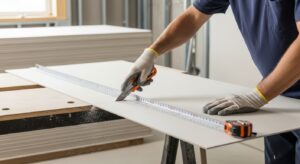
Angular and pressure control are very important in precision cutting. In case of excessive pressure, the surface can break.
In straight cuts, it is straight motion, whereas in curved cuts, it is slow motion. Having lines of marking ensures uniformity. Corners and junction points are carefully paid attention to in order to eliminate gaps in finishing.
Common Mistakes During The Drywall Cutting Process
There are a few typical errors that are made when cutting drywall:
- Ignoring measurement
- Deep scoring
- Splitting the angle inappropriately
- Keeping the surface unsupported
- Deviation on a line when cutting
All these errors have a direct impact on the quality of installation. These problems can be prevented with the appropriate practice.
Safety Considerations While Learning How to Cut Drywall
Drywall cutting is not a hazardous operation; however, caution should be taken. Sharp edges and dust can be revealed when cutting.
The area of work must be clean and stable. The material must be on a flat surface. Limited movements decrease the chances of accidental injuries.
Advanced Understanding of Cutting Patterns
Straight lines are not the only ones you can cut drywall with. L-shapes and openings are as well made in complicated layouts. For this, sequential marking and step-by-step cutting approaches are used.
It is more precise when it is cut into small pieces and corrected afterward. This is a method of keeping architecture on track.
Material Behavior and Structural Response
The structure of the drywall is stratified, and the material in the core is brittle. Due to this, it is necessary to have controlled scoring. Knowledge of material response enhances efficiency in cutting. All the sheets respond to pressure differently and have predictable behavior.
Environmental Factors Affecting Cutting Accuracy
There are also effects of temperature and humidity on cutting performance. When it is very humid, the material can be slightly soft whereas in dry weather the material is more brittle. As a consequence, it is best practice to cut in a stable environment. With stable conditions, there is a reduction in the risk of edge cracking.
Conclusion
The cutting of drywall is a systematic operation, which relies upon an evaluation, scoring, breaking and finishing., The correct planning and execution are used to attain clean edges and professional results. The material understanding and precision techniques are both significant in this process.
The emphasis of how to cut dronal is on precision and quality control, which is directly transferred to the quality of the installation. It is important to take a rational sequence of every step.
Finally, it takes knowing the details and performing each cut with care – if not all straight lines are the outcome of an accurate decision.
FAQs
What to do to cut drywall without compromising edges?
In order to cut the drywall, it is required to make measurements and score lightly. The edge is kept smooth and not damaged with the use of controlled breaking techniques.
What is the most crucial step when cutting drywall?
Correct measurement and straight marking is the most crucial restep. Any error in stepping will interfere with the entire cutting process, and will result in more wastage.
What is the way of cutting curved shapes in drywall?
In the case of curved shapes, slow controlled scoring and passages are employed in multiple shallow passes. This enables the material to develop a smooth curve as opposed to fracturing unevenly.